Posts Tagged With: blogginforli

The Good Life in Emilia-Romagna: Forlì

Buongiorno a tutti!

I hope you’re all well and have been waiting with baited breath for the fourth part in the Settimana del Buon Vivere Pentalogy! We went far and wide during our week away in the search to discover why the region of Emilia-Romagna has come to be known as the region of “good-living”. We went on bike rides, boat trips, art tours and explored Forli, Ravenna and Cesena so all in all, it was a packed schedule! In this post I’ll write about some of the hidden gems we discovered in Forlì.

Waterworks of Forli

Forli is a comune and city in Emilia-Romagna and is the capital of the province of Forlì-Cesena. It comes from the Latin name for the town “Forum Livii”. I suspect in the UK, not many of you will have heard of Forlì but it played an important role in Italy’s history and has been the home to some of their more famous and forward-thinking people. In fact, the squares and roads are dedicated to one of the citizens they’re most proud of, Aurelio Saffi, a Politian active during the unification of Italy in the 19th century. More on him later…

The theme of the Settimana del Buon Vivere this year was ‘Water’ so with that in mind we had an ‘urban trek’ organised in partnership with the Municipality of Forlì to discover ‘Forlì, the city of water`. Now to be honest, when you walk around Forlì the first thing you think is not “wow, look at all this water” so I was intrigued. However, it really is a city of water; it’s just that you can hardly see any of it!

We started off at the Rocca di Ravaldino (also known as Rocca di Caterina Sforza) where our excellent tour guide, Gabriele Zelli, gave us an insight into how important water was for Forlì in the past.

forli-4-of-16

Rocca means ‘stronghold’. Here’s the Rocca…

Gabriele told us about the past lives of the castle which was a defensive home of Caterina Sforza (the Countess of Forlì – have a look at her Wiki page, she was quite a character!) and its subsequent takeover by Ravaldino and then eventually its use as a prison. A moat ran around the castle which is now filled in and canals ran very close to it, and in fact still do, underneath roads and houses.

The canals were essential for farming and industry. A number of mills and tanning factories were set up along the canals.  Forlì also has a long history of making sugar from a type of beetroot (sugar beet) which needs a lot of water which was why the canals were so important to the city. Along the canals there were also public wash-houses (lavatoio) where people washed their clothes. However it wasn’t always an easy relationship Forlì had with water; poor quality drinking water led to thousands falling ill each year from typhoid and dysentery etc.
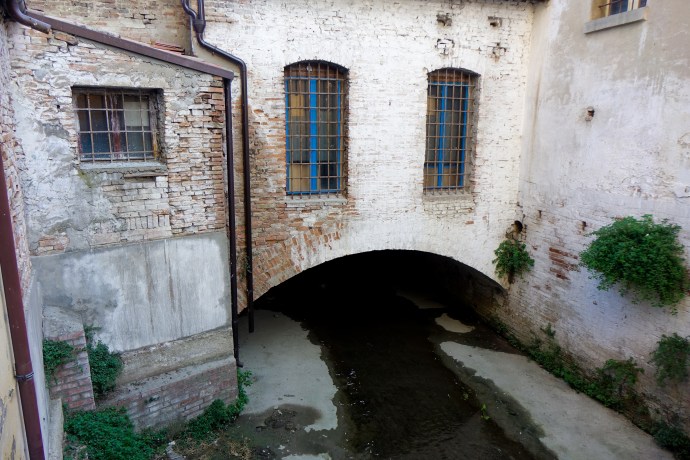
forli-12-of-16

Today, after further development of the city the canals are almost totally covered, apart from this part in the main city. They are still in use though by the farming industry.

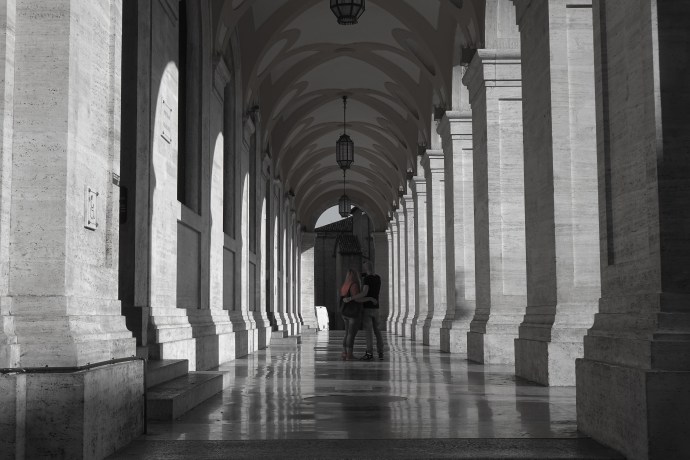
Forlì has a diverse range of architecture, demonstrated perfectly in Piazza Saffi, the main piazza. Here you can see buildings from both the renaissance period, the fascist period and the 1960’s (what were those architects thinking?!)
forli-9-of-16

A romantic scene snapped under the arches of the Post Office, in Piazza Saffi, constructed during the Fascist era!

This is Piazza Saffi with its eclectic architecture…

And these were some snaps taken during our tour. I loved this beautiful image painted on the side of a building near the San Giacomo church.


The Risorgimento at Villa Saffi

Villa Saffi is on the outskirts of the main town of Forlì and was the home of Aurelio Saffi, the Italian Politician that the Forlivese (residents of Forlì) are very proud of. He was an active protagonist in Forlì’s ‘Risorgimento’ (the fight for the liberation and unification of Italy between 1750–1870) and was a good friend of Giuseppe Mazzini. Mazzini led the movement. The Risorgimento was unsuccessful and they were exiled to the UK where Aurelio met his wife, Giorgina Craufurd (the least sounding English name ever – I assume she got fed up of Italian’s trying to pronounce Georgina Crawford and changed it!)  Years later they moved back to Forlì and lived there until their deaths. It is possible to take a tour around their house and see where secret political meetings were conducted, the ice-house, a lovely wall mural in the “table tennis room” and some of the niftiest furniture I’ve ever seen. In fact, there’s barely an item of furniture in the house it seems that doesn’t have some secret compartment, trick to using it or can turn into something else entirely.

Look at these signatures below. My photos are a bit blurred unfortunately but aren’t they beautiful?! There is a remembrance book full of them for those that came to the funeral of Giorgina. It’s made me realise just how awful my signature and general handwriting is. Even the recipe below, an original from the kitchen, looks elegant!


Restoring books at the Laboratorio del Restauro Libri

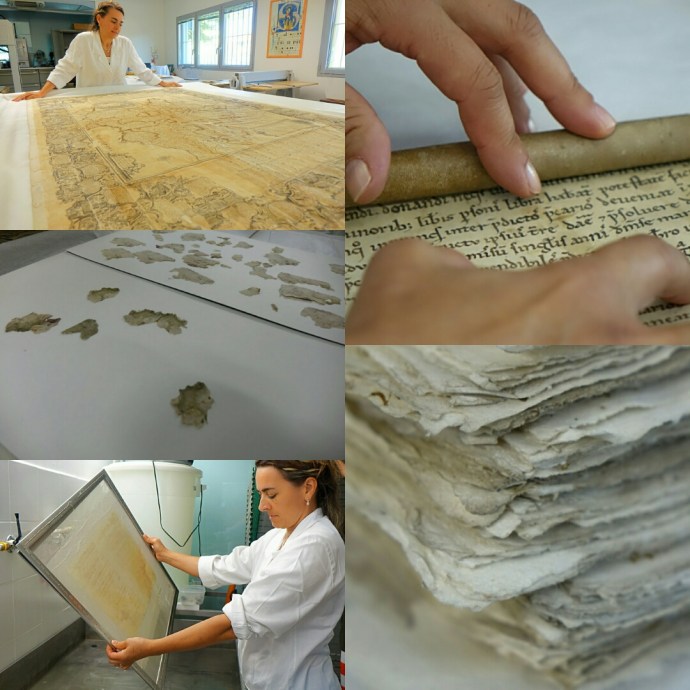
We also went to the Laboratorio del restauro libri in Forli to see how books are restored. This isn’t a tour open to the general public but for those interested in how the process works, tours can be arranged (see contacts in the link above). This was definitely one of the most fascinating parts of our week. I am just absolutely gobsmacked by the work they do here. If you saw the state of the books they restore, it’s amazing the team aren’t rocking back and forth in the corner of the room having gone completely mad! I don’t know of any other job where you would need as much patience.

They carefully number the pages which is a challenge in itself because often the pages are all stuck together. Then they wash each page in a large sink and carefully dab away any mould in the corner and then they reassemble it using traditional bookbinding techniques. When parts of the pages become separated and they don’t know where they’re from, they collect the pieces together and it becomes like a sort of mammoth jigsaw puzzle to work out which one of the hundreds of pages the missing part came from!

The amount of work and dedication involved is enough to make your eyes water. The restoration work for one book can take weeks, if not months. Books come in from private collectors or libraries around Italy and the team provide a quote for the clean-up operation. (Forlì is lucky that I’m not managing this team – I like books and I think it’s great to preserve our history but my patience is such that I would have written back to the library or private collector to suggest they just preserve it in its current state as a hunk of mould!) So, in summary, I’m full of admiration for this team and if you fancy doing something a bit ‘off the beaten track’, an organised tour here is absolutely fascinating.
img_20160927_082607

Check out the Biblioteca Saffi

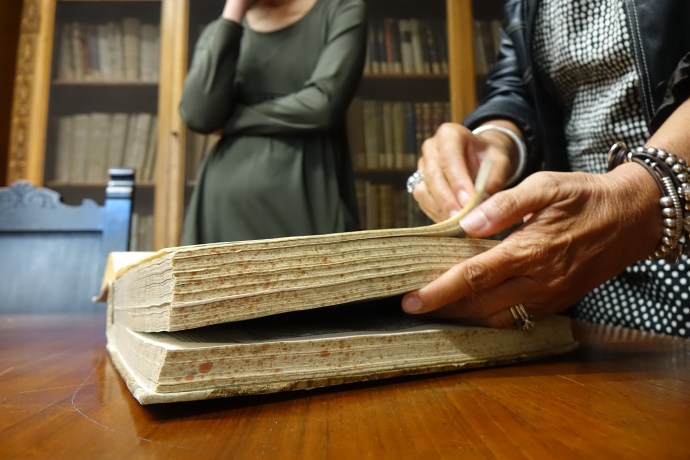
Continuing with the book theme, Biblioteca Saffi is also definitely worth a visit (visits should be organised in advance – contact details in the link). Biblioteca means library (confusingly “Libreria” means bookshop!) and this one is located a short walk from Piazza Saffi. It houses the most amazing collection of books, paintings and other objects donated by Carlo Piancastelli, a collector with a passion for……..well, everything! The collection includes old letters, books, score music, maps, portraits and sculptures and spreads across a number of rooms. To me a “collector” implies someone that collects for a hobby but I think it was akin to a full-time job for Carlo. It’s certainly an impressive legacy to leave.
forli-2-of-16

If you want to read more about Forli, have a look at my previous blog post Touring Forlì and tune in for the next blog post about other things you can do in the area!

A presto,

x


Categories: Uncategorized | Tags: , , , , , , , , , , , , , , , , , , , , , , , , , | 2 Comments

Touring Forli…

Buongiorno a tutti!

I’ve been on a Blog Tour! Never heard of one of those? Neither had I until a month or so ago when I was invited along as part of a tour by Romagna Fulltime and the Camera di Commercio di Forlì to explore the city of Forlì (note the accented “i” which means you pronounce it Forleee!). There were only seven  other fellow bloggers here with me so I felt thoroughly honoured to be invited along. As it turns out I’ve been following some of these bloggers for years so it was lovely to meet them in person and I’m thrilled to have discovered some new blogs too. We were a diverse bunch, each with  our own individual perspectives. My fellow bloggers are experts in art, history, wine, food and architecture and then there’s me of course, more of a jack of all trades and master of none!!!!!!!!! Anyway, to hear what the others have to say about Forlì, check out these blogs:

As a bit of background, Forlì is a city in Emilia-Romagna (the next region to the north of Le Marche where I live). It’s a nice city. It doesn’t have the grandeur of places like Rome and it’s definitely not quaint. In fact, the city initially has a bit of a utilitarian feel to me. From a purely superficial standpoint it would be easy to overlook Forlì because of that, but don’t! It’s interesting BECAUSE of that. It’s the architecture, and the history behind it that sets it apart from other Italian cities and makes it well worth a visit. Apart from the cultural and architectural aspects, the town authorities are passionate about Forlì as a base for art and exhibitions. I visited Forli for the first time earlier this year to see an exhibition of one of my favourite artists Giovanni Boldini, an absolutely amazing portrait painter from Ferrara (one of the nearby towns). It was an excellent exhibition so I was already somewhat pre-dispositioned to like Forlì  from an artistic perspective anyway.  However, we had a whirlwind tour of three other exhibitions (some of which served to further my  confidence in my own artistic abilities!) and it’s only added to my esteem in that regard.

As an aside, if I’ve got any of the information in this blog wrong, then it’s entirely my fault. The talks and the Guides were excellent but my Italian translation skills at speed, particularly after wine and massive meals sometimes leave a little to be desired!

Anyway, here are some photos taken around the town…


Architecture – Fascist and otherwise

We had a very interesting walking tour from Bernadette, our guide, focusing on the architectural side of the city. If you want to do this yourself, everything is in very easy walking distance of the center and there are lots of maps to help you find your way at the Information Tourist Office.

Mussolini, the Italian Dictator, was born 15km away from Forlì in a town called Predappio. I don’t think this was adequately impressive enough as a town in its own right so Forlì took on the role of being his more public “home”. It was an important place for him and his regime and there are a lot of reminders of that around the city . There are a lot of people who like Mussolini in Italy, including most of my neighbours. We learnt about him in school in the UK, none of it particularly good, so it was a surprise coming to Italy and hearing about how many still to hold him in such high regard. However, in Forlì, I can see why people might have liked him and still do. There were vast parts of Emilia-Romagna completely under-developed and covered in bogs. Mussolini extended railway networks, built schools and housing and developed industries on otherwise unused land.

My favourite part of the tour though was a stop off in what is now a school but previously, was the ex Collegio Aeronautico (Aeronautical College, Piazzale della Vittoria). A series of black and white mosaics cover the walls and show the history of air travel from start to finish (well, not quite  “finish”, things have carried on a bit since then). It was fascinating! Click on the images for more information…

If you’re interested in Fascist Architecture, then check out the Atrium Route. It’s a tourist itinerary connecting several countries in Europe which have cultural heritage of different totalitarian regimes. Forlì is on the route, as is Predappio (Mussolini’s hometown). The pack we received as part of the tour is pretty extensive and comes with information cards for each of the main sites. I’ll be keeping it in mind if I venture further afield.

Though there was a focus on the Fascist architecture on the tour, actually for me, of note are the number of houses that have frescos just beneath the roofs, all with different designs. Really quite pretty. You don’t see that in my area!

The Verzocchi Collection at Palazzo Romagnoli

This exhibition was in Palazzo Romagnoli, an interesting building in itself with frescos on almost all of the ceilings. It’s a nice place to wander around. Verzocchi was Forlivese (meaning someone that comes from Forlì) and an entrepreneur. He commissioned paintings with the theme of “Work”. There are about seventy all in all and they show not just a slice of history in terms of the type of work back in those days, but also the style of paintings. They all had his brand “V&D” painted into the picture, usually on a brick. It’s quite a challenge to find some of them! My thoughts on this exhibition? I really like the idea that this entrepreneur requested paintings from people with only two criteria – the theme and the brand. There should be more of that! From a wanna-be-artist perspective, I found this collection an odd mix of inspiring and frustrating. I’ve included below three of the ones I found most inspiring/frustrating with  my rationale.

So, in summary, I’m always worried to present myself as an “artist” but no more; if these guys can get away with it, so can I (and now you can see perhaps why I’m not a famous art critic). On a separate note, there’s little information about this collection online. If you’re interested, visit!

Afro, Pensieri nella mano at Musei San Domenico

This building is ideal for exhibitions. It’s a converted ex-convent and where I saw the Giovvani Boldini exhibition a few months back. Currently the downstairs is dedicated to the works of Afro Basaldella, an Italian painter  (1912 – 1976). Afro seemed to do a bit of everything; painting, tapestry, jewellry makingand printing.

His works are a bit too abstract for my liking but I appreciate his diversifying into different mediums!

Steve McCurry at Musei San Domenico

Now this was spectacular. I suspect many of you will know some of his most famous photos, even if you didn’t know his name. The exhibition is entitled “Icons and Women” and is a photo journal of his time travelling the world. His photos are amazing. The subject matter, the composition, the photos themselves… they’re just absolutely stunning, each and every one. Our guide was very knowledgeable and was able to recount the stories behind many of the photos making it even more interesting. The exhibition is breath-taking. I thoroughly recommend going!

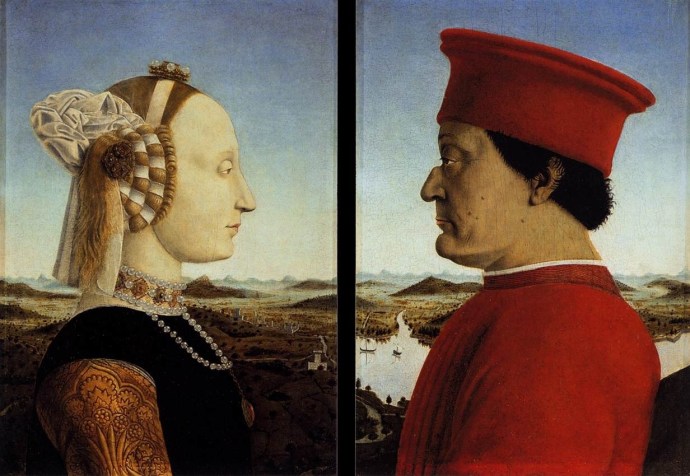
The next exhibition at the San Domenico Museo is dedicated to Piero della Francesca, Indagine di un Mito (Investigating a Myth) from the 13th February 2016. We had a sneak peak at some of the paintings (or at least, photos of the paintings) that would be included in the exhibition and there are some I recognised from other exhibitions in the area. I think my favourite painting of his is of the Duke and Duchess of Urbino. I always thought with portraits that you’re supposed to paint your subject with an element of flattery. Poor Duke. Piero must have been a brave man. Anyway, it’s an interesting style of portrait. You don’t often see portraits in full profile and the vast background makes it pretty unique. I’m hoping to go back to Forlì to see the rest of the exhibition.

Duke

Churches

My neighbour has drilled it into me that I must visit every church I come acrosss. I did my duty in Forli. Evidence included below.

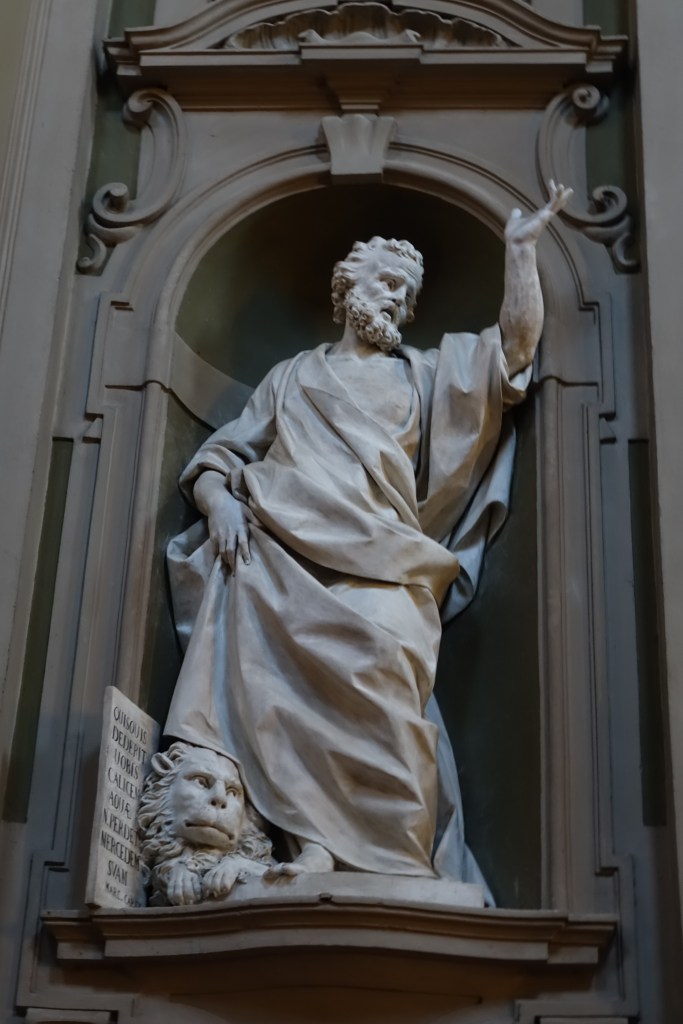
She often tells me that the churches are where most of the artistic masterpieces are and she’s right. This is my new favourite statue…

Forli (15 of 47)

Where better place to keep your creepy looking lion?


Where to eat

As part of the tour we ate at a couple of restaurants. On the first night we went to Salume’.  It’s highly rated on TripAdvisor and I can see why. The food was great. They had some good vegetarian options too and a massive selection of wine it seemed. The service was good and the restaurant stylish and intimate. The mascarpone cream desert was gooooooood.

The next day we had lunch in Eataly, a chain of restaurants and seller of Italian food products. The Eataly in Forlì is the first one I’ve come across but there are others around Italy too. It was in a superb location, in the main square (Piazza Saffi) and there are great views from the piazza from the third floor where the restaurant is.

Where to stay

We were based in Hotel Massini which is a minute or so walk from the main piazza so very central. The service was good. They didn’t even complain when I forgot to check out!

Travelling around

Forli (7 of 47)

It’s easy to get around the center in Forli just on foot but there are bikes to hire if you’d like and if you want to go further afield, there are buses and good train links to the local area.

Summary

All in all, it was an interesting couple of days and I’d certainly recommend a visit. If you’re coming from outside the area then it would be easy to combine it with a tour taking in Ravenna (click here for my review of Ravenna!), Rimini, San Leo and San Marino (I went to those in one fell swoop – read about it here). There’s even a Romagna Visit Card which will allow you to get into some of the main sites at a discount or for free.

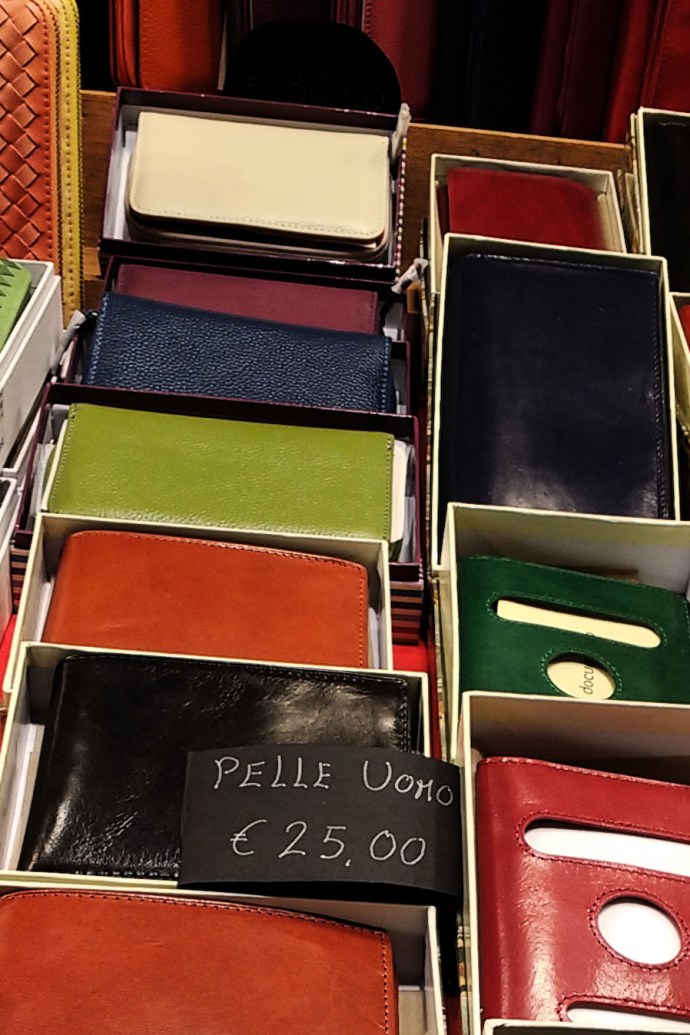
Finally, something that made me chuckle (but not the woman at the stall)…

Forli (21 of 47)

Forli is the only place I know of where you can buy wallets made of man skin (ok, OK, I can see that perhaps the more likely translation is that these wallets are made out of leather and are for men but I prefer my version!).

If you have any questions on Forli, or if I’ve made any heinous errors, or if you’d like to  invite me on a Blog Tour (I would like to make it clear that I’m available to travel abroad too… the Maldives, the Bahamas…), then please get in touch!

Have good weeks all,

x

Categories: Uncategorized | Tags: , , , , , , , , , , , , , , , , , , | 7 Comments

Blog at WordPress.com.